






What is an oil film bearing?
Oil film bearing is a radial sliding bearing that uses lubricating oil as the lubricating medium. It reduces friction and wear between the shaft and the bearing through the formation of lubricating oil film.
The working principle of oil film bearings is mainly based on the principle of dynamic pressure lubrication of fluids. When the journal rotates, lubricating oil is brought into the bearing gap. Due to the relative motion between the journal and the bearing, as well as the viscosity of the lubricating oil and the hydrodynamic pressure formed by the wedge-shaped gap in the bearing pair, a gap will be formed. Carrying oil film. This oil film can balance the load, isolate the journal and bearing, and convert the solid friction between metals into molecular friction within the liquid, thus greatly reducing friction and wear.
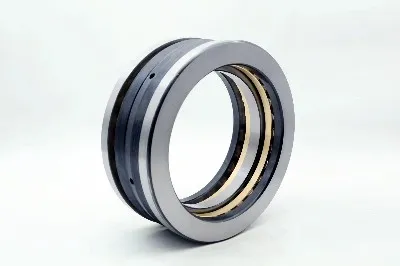
Oil film bearings usually consist of an inner ring, an outer ring and rolling elements (rolling elements may not exist in some sliding bearings). The inner ring is fixed on the shaft, and the outer ring is fixed on the bearing seat. As the shaft rotates, lubricating oil is introduced into the bearing, forming an oil film.
advantage
Low friction: The formation of oil film greatly reduces the friction between the shaft and the bearing.
Long service life: Due to low friction, the wear of the bearing is also reduced accordingly, thus extending the service life of the bearing.
Can withstand higher loads and high-speed rotation: Oil film bearings can withstand higher loads and high-speed rotation, and are suitable for heavy-load, high-speed mechanical equipment.
Application areas
Oil film bearings are widely used in industrial production, especially in mechanical equipment under heavy load, high speed, high temperature or special working conditions. For example, in metallurgical equipment, oil film bearings are often used to support high-temperature, high-pressure, and high-speed work rolls; in large hydropower generating units, oil film bearings are widely used to support the rotating parts of hydraulic turbines, such as rotors.
Classification
Oil film bearings can be classified in different ways:
Classified according to the load-bearing direction: it can be divided into two categories: radial bearings and thrust bearings.
Classification according to the principle of oil film pressure generation: it can be divided into two categories: dynamic pressure bearings and static pressure bearings. Among them, the dynamic pressure bearing uses the oil film pressure established in the gap between the journal and the bearing to balance the load on the rotor, while the static pressure bearing injects high-pressure lubricating oil into the bearing gap through an external oil supply system to form a load-bearing oil film.
Oil film bearing is a radial sliding bearing that uses lubricating oil film to reduce friction and wear. It has the advantages of low friction, long life, and can withstand high loads and high-speed rotation. It is widely used in industrial production.